
Car Expenses

Written by

Invested In You
This is why our professional services go well beyond tax compliance and corporate accounting services. At Curve Accountants, our comprehensive approach is designed to present you with proactive, tailored advice that allows you to make smart financial decisions. From strategies for managing wealth and minimising tax to succession planning and business restructuring, we are committed to offering advice tailored to your unique situation.
What’s under the bonnet?
If you use your own car for work purposes (this may be a car you own, lease or hire under a hire-purchase agreement), you can claim a deduction using either the cents per kilometre method or logbook method.
You can claim a deduction for car expenses if you use your car to:
 perform your work duties attend work-related conferences or meetings away from your normal workplace travel directly between two separate places of employment if neither of the places is your home travel from your normal workplace to an alternative workplace and back to your normal workplace travel from your home to an alternative workplace and then to your normal workplace perform itinerant work – meaning you had shifting places of employment (for example, you regularly worked at more than one site each day before returning home).
Remember
- You can’t claim a deduction for the cost of trips between home and work under any of the methods, even if you live a long way from your usual workplace or work outside normal business hours.
- In limited circumstances you can claim the cost of trips between home and work, where:
– your home was a base of employment (that is, you were required to start your work at home and travel to a workplace to continue your work for the same employer)
– you had shifting places of employment (that is, you regularly worked at more than one site each day before returning home)
– you were required to carry bulky tools or equipment for work and all of the following conditions were met
- The tools or equipment were essential for you to perform your employment duties and you didn’t carry them merely as a matter of choice.
- The tools or equipment were bulky – meaning that because of their size and weight they were awkward to transport and could only be transported conveniently by the use of a motor vehicle.
- There was no secure storage for the items at the workplace.
- If your travel is partly private, you can only claim the work‑related part.
- You can’t claim a deduction if you have been reimbursed for your expenses.
- You can only use one of the methods to calculate your deduction for car expenses.
- If you claim car expenses for more than one car, you can choose to use a different method to calculate your expenses for each car.
- If you claim a work-related car expense using the cents per kilometre or logbook method, you can’t claim any further deductions in the same tax return for the same car.
- If you use someone else’s car for work-related purposes, you can only claim a deduction for actual expenses, such as fuel, in the work-related travel expense section of your tax return. Cars owned or leased by someone else may include a spouse, family member or employer. However, if you can show there is a family or private arrangement that made you the owner or lessee (even if you are not the registered owner) you can calculate your car expenses using either the logbook or cents per kilometre method.
- A vehicle is not considered a car if it is a motorcycle or a vehicle that:
- has a carrying capacity of one tonne or more, such as a ute, truck or van
- can transport nine passengers or more, such as a minivan.
For these vehicles, you can only claim a deduction for actual expenses you incur when you travel for work (such as fuel). Claim your deduction as a work-related travel expense in your tax return. We recommend keeping a logbook for these vehicles as an easy way to show how you calculated your workrelated use of the vehicle. You must also keep records of all of
your actual expenses.
For more information, visit https://www.ato.gov.au/tax-and-super-professionals/for-tax-professionals/prepare-and-lodge/tax-time/tax-time-toolkits/tax-time-toolkit-small-business/small-business-guides/travel-expenses
What’s under the bonnet?
Cents per kilometre method
- You can claim a maximum of 5,000 work-related kilometres per car using this method.
- You can claim 91 cents per kilometre for the 2026-27 financial year(72 cents per kilometre from 1 July 2020).
- The cents per kilometre rate incorporates decline in value, registration and insurance as well as maintenance, repairs and fuel costs. You can’t add these expenses on top of the rate when calculating your deduction.
- You need to be able to show how you worked out your work‑related kilometres (for example, by producing diary records of work-related trips or using the myDeductions tool in the ATO app to track your work trips).
- You will also need to have evidence that you own the car.
Logbook method
- Your claim is based on the work-related percentage of expenses for the car.
- Expenses you can claim include running costs and decline in value.
- You can’t claim capital costs, such as the purchase price of your car, the principal on any money borrowed to buy it and any improvement costs (for example, adding paint protection
and tinted windows). - To work out your work-related percentage, you need a logbook and the odometer readings for the start and end of the logbook period. Your logbook period needs to show a continuous, representative 12-week period.
- You can claim actual expenses you incur for fuel and oil costs using your receipts or you can calculate these expenses based on odometer records that show readings from the start and the end of the period you used the car during the year.
- You need written evidence for all other car expenses, including evidence that you own the car and odometer readings at the start and end of the period you used the car during the year.
Keeping a logbook
Your logbook must cover at a minimum 12 continuous weeks. If you started using your car for work-related purposes less than 12 weeks before the end of the year, you can extend the 12-week period into the next financial year.
Your 12-week logbook is valid for five years. However, if your circumstances change (for example, if you change jobs or move to a new house) and the logbook is no longer representative, you will need to complete a new 12-week logbook.
If you are using the logbook method for two or more cars, keep a logbook for each car and make sure they cover the same period.
You can keep an electronic logbook by using the myDeductions tool in the ATO app or keep a paper logbook.
Below is an example of the details you need to keep.
Car details
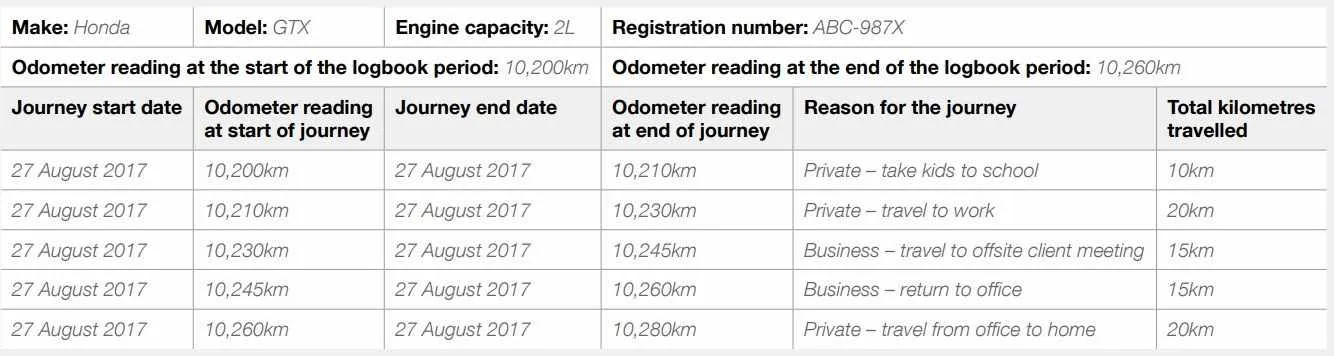
Calculate your work-related car use (Complete this section after 12 continuous weeks of logbook use.) Logbook period (dd/mm/yy to dd/mm/yy)
a. Calculate the total number of kilometres travelled during the logbook period:
b. Calculate the number of kilometres you travelled for allowable work-related trips during the logbook period:
c. Calculate the work-related use by dividing the amount at (b) by the amount at (a) then multiply this figure by 100.
Your work-related percentage is:
Once you’ve calculated your work-related percentage, multiply it by your car expenses to calculate your claim. The myDeductions tool in the ATO app can be used to record work-related car trips as well as any car expenses.
You can share your myDeductions records directly with your agent at tax time. For more information, visit https://www.ato.gov.au/online-services/online-services-for-individuals-and-sole-traders/ato-app/using-mydeductions/mydeductions
Helpful tip:

Keep accurate records of your business travel, including logbooks and receipts where required. Only claim expenses that relate to earning your income and use the appropriate calculation method. Good record-keeping throughout the year will make tax time much easier.
BERIVAN DUBIER
DIRECTOR
Reviewed by

SEAN DWYER
Edited by

Alix Dower
PRACTICE MANAGER
Free eBook Download

Starting A Medical Practice
David has extensive experience in writing, editing and marketing before joining iSelect in 2023 as Digital Editor. When not making our content better, you can find them browsing log cabins for sale in the forest.
REQUEST DOWNLOAD

Buying An Established Medical Practice
REQUEST DOWNLOAD
FAQ
When can I claim car expenses for work?
Can I claim my drive between home and my usual workplace?
What are the two ways to calculate a claim for my own car?
What is the cents per kilometre rate for 2026–27?
Do I need receipts or a logbook for the cents per kilometre method?
How does the logbook method work?
Can I claim an expense my employer reimbursed?
Do the car methods apply to a motorcycle, heavy ute or someone else’s car?
Related Blogs

How Tax Deductions and Offsets Work in Australia
Understanding the difference between tax deductions and tax offsets can help you make better financial decisions and avoid paying more tax than necessary. While both can reduce...

2026-27 Federal Budget – What the Federal Budget means for you, your family, and your business
BERIVAN DUBIER Last Updated May 13, 2026 | Fact checked | Your financial journey is an inherent part of your well-being and happiness. When you feel confident and your finances...

Payday Super FAQs for Small Business Clients
From 1 July 2026, the way employers pay super is changing. These FAQs explain what Payday Super means for your business, what’s different, and what you need to do to get...
Find Out How Curve Accountants Can Help
